IMPORTANT: PLEASE READ BEFORE REVIEWING THE FIGURES ABOVE
This is an asset-heavy business. The price includes the operating fleet, and the earnings figure includes a large non-cash depreciation add-back. Seller’s Discretionary Earnings of $481,605 is stated after adding back approximately $386,000 of depreciation. The fleet is real and included in the purchase price, but tractors and trailers wear out and are replaced. A buyer should expect ongoing capital expenditure on equipment and should evaluate earnings on a basis that reflects it. The company’s stated policy is to retire power units at approximately 500,000 miles, and one unit is scheduled for replacement.
The company also earns a $30,000 annual management fee from an unrelated trucking partnership. That fee is not part of the trucking operation, is not expected to transfer, and has been removed from the figures above.
Revenue concentration is significant. Approximately 80% of revenue comes from a single carrier the company has been leased on with for roughly eight years. This is normal for a leased-on fleet, but it is a concentration a buyer should size before proceeding.
THE BUSINESS
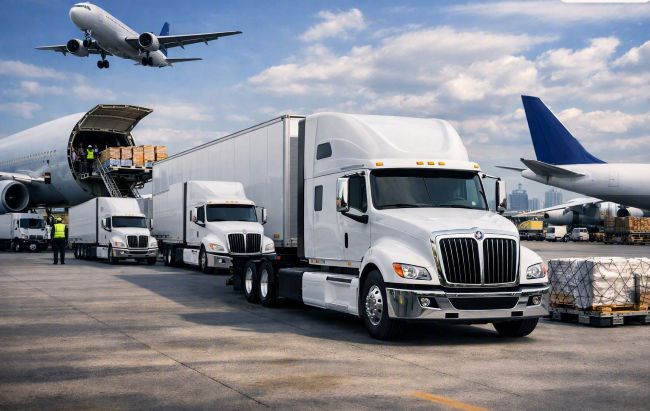
The company operates a fleet of team-driven tractors leased on to established freight carriers. Its principal line is aviation freight: engines, crates, and other high-value aerospace cargo moved on 53-foot step-deck trailers under tarp and securement. It also runs dry van freight. Florida is the company’s primary geography and the base of its principal carrier relationship, with continuing operations in Ohio, where the limited liability company is registered. The trucks run in all 48 continental states, and the business is not tied to any single lane or region. It has operated as an LLC since 2013 and, before that, as a sole proprietorship dating to 2006. The owner has been in trucking for approximately 45 years.
The carriers dispatch the loads and handle all DOT compliance. The company supplies the equipment, the drivers, and the specialized tarps and securement gear, and the owner manages drivers, equipment, and maintenance. That division of labor is why a business of this size runs on roughly 20 hours of owner time per week with no office staff and no back-office software. The aviation work is the more profitable line and is protected by a real skill barrier: few over-the-road drivers can properly tarp and secure an aircraft engine, and fewer still want the physical demands of the work.
BUSINESS HIGHLIGHTS
A defensible niche rather than commodity freight. Aviation step-deck work requires drivers who can secure high-value aerospace cargo to the carrier’s standard. It is the company’s most profitable line and the majority of its revenue, and it is not a lane any dry van operator can simply enter.
Debt-free with an owned, recently refreshed fleet. All equipment is owned free and clear. Nothing is leased, and the company has no debt. The fleet has been substantially renewed since 2022, including 2022 through 2024 model-year Volvo, Western Star, and Freightliner power units and 2023 and 2024 Dorsey drop-combo step-deck trailers.
Long-tenured carrier relationships. The company has been leased on with its principal aviation carrier for approximately eight years and with a second national carrier for approximately ten years. The owner reports that both carriers would honor the existing leases with a new owner.
A largely variable cost structure. All ten drivers are 1099 independent contractors, paid by the mile on dry van and by percentage on aviation, so the largest single cost line moves with revenue. The carriers provide dispatch, compliance, and ELDs. There is no dispatch staff, no compliance department, and no software licensing.
Owner-operated at roughly 20 hours per week. The owner’s time goes primarily to equipment and maintenance management rather than daily operations. His spouse, previously active in the business, retired in 2024 and now works only a few hours a week.
Material unused capacity in the existing fleet. The owner reports running some units at only 50% to 60% utilization because he stopped recruiting while winding down. He states the current fleet has produced over $3,000,000 of annual revenue in prior years and should do so again for an owner willing to recruit. Revenue reached $3,346,024 as recently as 2022. After two years of deliberate downsizing, 2025 revenue rose approximately 18% over 2024.
Identified cost reductions. The owner has documented a schedule of recurring expenses a buyer could eliminate or shift to drivers, including trailer rental, extended warranties, escrow, permits, and truck washing, now that the fleet is fully owned.
Transition support. The owner will provide as much training as a buyer needs and is willing to remain for up to one year. He estimates a buyer with trucking experience would be comfortable within a few months.
REVENUE HISTORY
2022: $3,346,024. 2023: $2,118,884. 2024: $1,982,716. Each per filed federal tax return. 2025: $2,344,180 per company-prepared profit and loss statement, stated after removing $30,000 of management fee income. Tax return and management statement presentations differ in their treatment of reimbursed expenses and other income; full reconciliations are available in the data room.
EARNINGS
Seller’s Discretionary Earnings for 2025 are built from net income of $214,087, less the $30,000 management fee from an unrelated trucking partnership, less $88,800 of gain on sale of fixed assets and $7,211 of insurance claim proceeds as non-recurring items, plus $386,239 of depreciation, $574 of interest expense, $5,421 of owner personal vehicle mileage, and $1,295 of meals. The result is $481,605. The owner takes no salary and is compensated through distributions, so no owner compensation add-back is required.
BASIS OF THE FINANCIAL INFORMATION
Revenue and earnings for 2025 are taken from company-prepared, cash-basis financial statements and are unaudited. Figures for 2022 through 2024 are taken from filed federal tax returns. Seller’s Discretionary Earnings is not net income, and it is not free cash flow. It is stated before depreciation, interest, taxes, owner compensation, and capital expenditure. The business is equipment-intensive and reinvests continually in its fleet, and prospective buyers should evaluate earnings on a basis that reflects that reinvestment.
Four years of financial statements and tax returns, a full equipment and depreciation schedule with current owner-estimated values, an owner-prepared schedule of discretionary and non-recurring expenses, and detailed responses to a standard information request list are available to qualified prospective buyers on execution of a non-disclosure agreement. Prospective buyers should conduct their own diligence and rely on their own advisors.
TRANSACTION AND PROCESS
The seller is retiring after approximately 45 years in the industry and is seeking a full exit at a fair price. The contemplated transaction is a sale of the business together with the fleet, free of debt. Several units currently sit without drivers and generate no revenue; their treatment in the transaction is open to discussion, and the owner will consider structures that address the equipment and the operating business separately. Closing would be subject to customary conditions, including confirmation of clear title to the equipment and confirmation that the carrier lease agreements will continue with the new owner.
This listing is a summary prepared on behalf of the seller and is provided for information only. It is not an offer to sell. No representation or warranty is made as to the accuracy or completeness of the information, which has been supplied by the seller and taken from company-prepared documents and filed tax returns. Financial statements are unaudited. All figures are approximate and subject to verification in diligence.

Sign our NDA to view more information.