Blake Taylor
What Does a Business Broker Do During the Sale Process?
When it comes to selling your business, there are countless moving parts and complex processes to navigate, and it can …
9 MIN READ
Read More

Finding the ideal buyer for your business can be a complex process. You’re not just looking for anybody who seems interested and has the financial means to match your offer. What if they are difficult to work with and want to make you jump through as many hoops as possible before they can feel ready? What if their vision contradicts your values? Perhaps you want a clean exit or are looking to retain some ownership.
Regardless, the right buyer for you should have goals that align with your exit objectives.
It’s essential to recognize that buyers differ in their motivations and priorities. You can transact with any buyer and possibly walk away with a deal that works for you, but your choice of buyer affects your exit goals and the buying process. Here are different types of business buyers to consider when looking to sell:
These buyers often acquire companies because of a strategic advantage they hope to gain. They usually fall into various categories, such as previous customers, suppliers, competitors or industry investors.
Keep in mind that strategic buyers rarely buy with the sole intention of a financial return, which means they are often willing to buy even if the business indicates revenue depreciation. They also tend to pay more for a business if the advantage they are eyeing is especially attractive.
Some of the strategic advantages these buyers would be looking for include:
While the motivations behind a strategic buyer’s interest vary, they are typically driven by a broader perspective.
Financial buyers can be individuals or entities looking to acquire businesses that demonstrate growth. Usually, their main focus is cash flow and will often have a timeline for recouping a return on their investment. Where business profitability and growth potential are high, attracting a financial buyer becomes easier.
One thing to consider when working with financial buyers is that they may seek full ownership or a partnership, depending on their portfolio.
Potential buyers for your business aren’t always external. Depending on the business structure and even the number of employees, potential buyers can be internal. These can be the management team or employees. In a management buyout, your existing management team buys you out and runs the business as a partnership.
In some cases, employees may come up with a structure that allows them to collectively purchase the business and operate it under the employee-owned model. Both management and employee buyouts represent a smoother transition and brand legacy. These buyers already understand how the business works, its customers, potential and proper valuation.
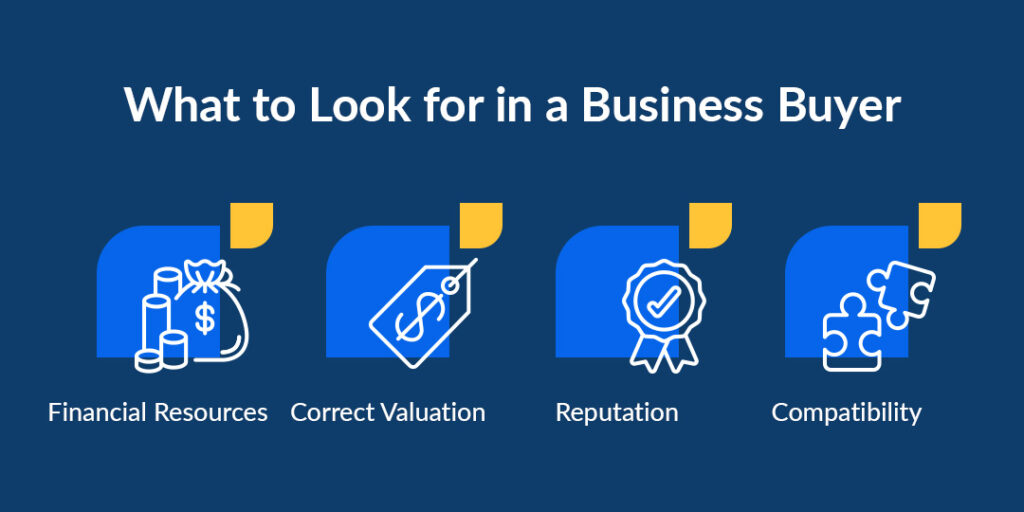
It’s one thing to know the type of buyers you may encounter, but what should you look for when considering potential buyers to determine who you want to work with?
Identifying the ideal buyer profile for your business is crucial but it’s only the initial step in the long and structured selling process. Here is a step-by-step process of actually finding and a willing and reliable buyer for your business:
Both parties will be involved in one of their biggest transactions. You’ve worked on your business and want the best value out of it, while a potential buyer has a large investment at stake. Before listing your business for sale, you need clarity on the reason behind the sale and what a successful exit looks like for you.
Define your motivation to prevent costly misalignments later in the process, whether you’re looking for retirement or reduced responsibility. When you lead with clarity, buyers won’t sense mixed motives that can weaken your negotiating power.
How much you’re selling your business for is a key factor but so are the terms of the deal. Determine what works for you. For example:
You want to understand the time frame that you want to sell your company in and work with buyers who are willing to work within your timeline.
Understanding what is most important to you in the sale of your company allows you to have a productive conversation with your Business Broker or M&A Advisor to see if those goals are realistic. They will review your financial information, learn more about your company, help you determine a possible selling price and develop a marketing strategy to find the best buyers for your company.
You want to keep an open mind, realizing that the best buyer may come from within your industry or possibly a related industry that can leverage your existing assets. The best buyer may also be an investor with the skills, resources and contacts to take your business to the next level. It may also be a private equity group seeking to consolidate multiple companies in your industry to leverage synergies between related businesses.
The more open you are about the type of buyer, the more buyers you will have to choose from and the higher the likelihood is of achieving your goals for the price, terms and timing.

With the right business broker, finding your ideal buyer is faster and smoother. At Synergy Business Brokers, we maintain a database of over 40,000 potential buyers for companies in technology, manufacturing, construction, distribution, healthcare, services, engineering and transportation.
If you own a company in one of these industries that has an annual revenue of $700,000 to $250 million, we offer a confidential consultation. We’ll discuss your goals for selling your company and get an idea of what you are looking for in a potential buyer. We also provide our ideas on how to help you achieve your goals, and work with you to find the right buyer for your company.
We take pride in being client-focused and providing our services with no up front fees until your company is sold. Contact us by completing our short online form or call us at (888)-688-4664.