
Blake Taylor
What Does a Business Broker Do During the Sale Process?
When it comes to selling your business, there are countless moving parts and complex processes to navigate, and it can …
9 MIN READ
Read More

High-profit-margin companies are desirable, and a lot of buyers want to purchase them. So one would think that almost every business owner who has a high-profit-margin company should be able to sell their business at maximum value whenever they want to exit the market. However, data has shown that, for a variety of reasons, many business owners fail to achieve a successful exit.
In fact, there are over 36.2 million businesses in the U.S. today, and recent data from the Exit Planning Institute shows that about 75% of business owners are considering whether to sell their business.
But, of all the businesses that make it to the market, the majority fail to sell, largely because they lack proper business exit guidance and strategy.
Still, every other week, business owners sell their high-profit business in a multi-million dollar deal.
What are these businesses doing differently?
Many business owners make the mistake of assuming that strong margins automatically translate into an immediate sale or a premium valuation. But in reality, high-margin business buyers also look beyond current profits to evaluate business sustainability, scalability, risk, and growth potential as very important indicators of a good purchase.
In this guide, you will learn:
For over two decades, Synergy Business Brokers has helped hundreds of owners sell profitable businesses successfully in the U.S. and overseas.
We have found that irrespective of industry, scale of operation, or complexity of the merger or acquisition process, buyers and their team of advisors and consultants always look out for some common signals in a business:

Most buyers prefer target companies that meet these criteria, as adherence goes a long way to minimize operational risks, curb hidden liabilities, enhance cash flow generation, and enable faster ROI.
Generally, checking these boxes places you in a strong position to attract high-value buyers, but at an industry or market level, buyers may also have specific interests and requirements.
Talk to an advisor to find out what buyers are looking for in your market and prepare adequately to meet their needs.
With high-profit-margin businesses operating at the mid-market levels, buyers are particular about the businesses they buy and will do due diligence to ensure all requirements are met.
However, selling your business shouldn’t leave you at the mercy of any buyer who shows interest. Depending on your company’s values, principles, or even market position, you should also have a say on who or how you’d like to sell your business.
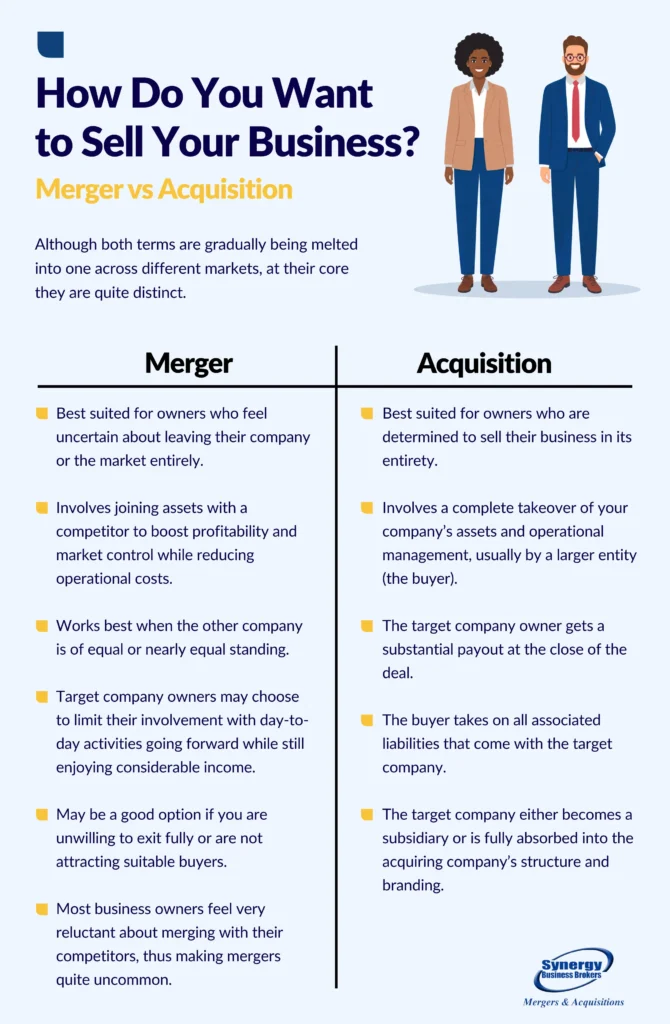
Although both terms are gradually being melted into one across different markets, at their core, they are quite distinct.
Merger
Acquisition
In any scenario, there are four major types of business buyers to consider when selling your high-value business, and each comes with differing motivations.
Not sure of what or who will give you the best value for your business? Talk to your business broker to assess these considerations and determine the best fit for you, especially regarding buyers’ motivations, valuation approaches, and the likelihood of offering higher value.
Now that you know the various types of buyers and what buyers are looking for in profitable companies, it is time to prepare your business to align with their interests and secure a premium deal.
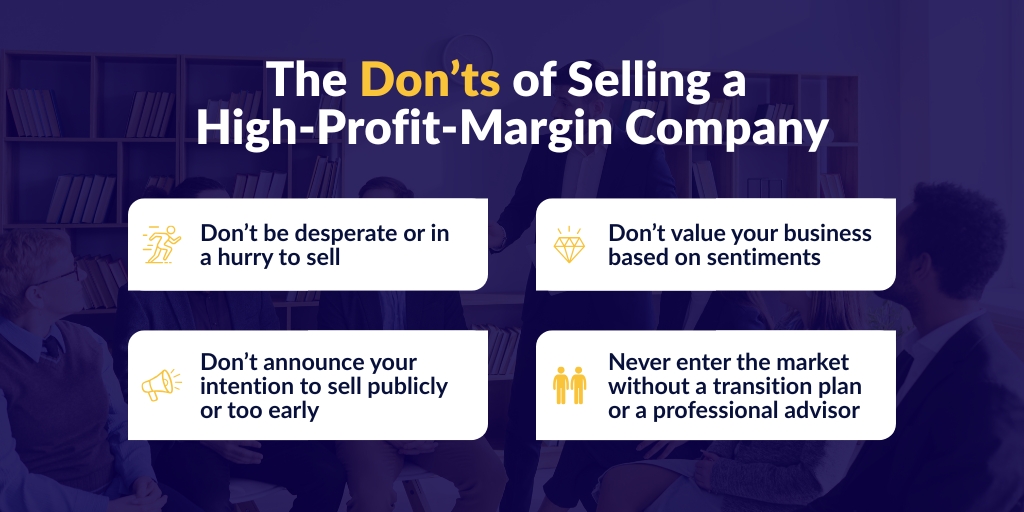
Below is a list of things you must do when preparing to sell your business for maximum value:
Review and compile all necessary documents in readiness for any relevant request. This may include:
Prepare your business for potential financial audits from different buyers by providing reviewed financial statements that enable accurate forecasting and seamless bookkeeping. This step may mean:
Top buyers usually encounter businesses that rely too heavily on the owner or founder to function. Start putting measures in place to assure potential buyers that they can run the business without you after closing the deal.
With all the proper documentation, delegation, and reporting in place, engage an experienced business broker to develop a practical deal structure to close the deal feeling satisfied.
For first-time business sellers, going into an M&A deal solo is quite the rookie mistake, especially when in a room with a buyer flanked by multiple analysts, advisors, and consultants.
In fact, approaching high-profile buyers alone might send a signal that you are running an owner-dependent business, which significantly increases the risk of the deal falling through.
As much as buyers value direct access to the visionary behind the target company, they generally prefer when owners come to the table with professional M&A brokers and advisors. This signals professionalism to serious buyers and provides the assurance that they are not about to go through drawn-out valuation or emotionally driven negotiations.
With high-profile buyers often comparing multiple target companies at once, it is therefore in the best interest of sellers that they put their best foot forward.
Working with a business broker significantly increases your chance of joining the ranks of business owners who sell their businesses successfully.
Award Winning brokers like Synergy Business Brokers provide a diverse portfolio of domestic and international buyers, which sellers can leverage to meet high-profile buyers. And sell their business faster at maximum value.
A reputable M&A firm can help keep your business sale process confidential, from initial consultation to close, ensuring you don’t suffer an information leak that jeopardizes operations mid-sale or fall at risk of sharing sensitive business information with illegitimate buyers.
An M&A business broker helps process and analyze your financial records and provides you with a well-informed asking price that reflects the value of your business while equally matching buyers’ expectations.
Reputable business brokers ensure that your business sale intent gets to the right audience by positioning your business to the potential clients in their database, as well as advertising in relevant marketplaces.
As part of the marketing process, they develop a teaser and confidential information memorandum (CIM) to serve as a buffer of confidentiality until you secure an interested buyer who meets your requirements.
Your broker matches you with the best-fit buyer, making sure that their motivations align with your business goals and values. If you are satisfied with the buyer’s profile, your broker then establishes a direct line of communication between you and the buyer.
Even if you are considering more than one offer, experienced business brokers can evaluate each on real merits, including the negotiation of individual assets, to help you get maximum value for your company and all its assets.
Fine print is often hard to catch, process, and understand. Having an M&A team ensures that all contracts are thoroughly scrutinized, combing through all the legalese to ensure you are coming out on top.
Ultimately, partnering with a business broker streamlines your exit strategy by conducting due diligence and managing the complex lifecycle of the sale.
Since 2002, Synergy Business Brokers has been helping businesses with $700,000 to $250 million in annual revenue sell their businesses with ease.
Our vast and provable experience across technology, healthcare, construction, manufacturing, distribution, and service industries means that your business will be carefully valued, buyers thoroughly vetted, your confidentiality protected throughout the sale process, and all the contracts you sign will be reviewed exhaustively.
And more importantly, our goal is for you to feel satisfied and confident that you have made the right decision at the close of the deal.
Ready to take the first step in selling your business? Contact us now to get started and experience firsthand why Acquisition International ranks Synergy Business Brokers as one of the best M&A firms in the U.S.
Besides high margins, buyers also determine if a business is profitable by assessing other factors, including the financial records, regulatory and legal compliance, customer base diversification, recurring revenue, owner dependency, and market position.
The timeline varies depending on the company’s size, industry, and market conditions, but most business sales take between six and twelve months from preparation to closing, but every year, we sell some in only a couple of months.
Preparing your company for valuation involves multiple considerations that ultimately compound to three key components: prepare documentation in advance, strengthen your financial reporting with the help of an M&A firm, and consciously reduce owner dependency.
You may sell your business on your own, but that comes at risk of losing confidentiality and signaling business owner dependency, which high-profile buyers may find greatly unappealing. You will also probably get less money.
With hundreds of closed business sale deals, a portfolio of 40,000+ qualified buyers in the U.S. and overseas, and multiple industry awards, Synergy Business Brokers stands out as one of the best M&A advisory firms for high-profit-margin business owners seeking maximum returns and professional, end-to-end business sale guidance.